Any complex problem in asset-heavy operations. One platform underneath.

The solutions below run in production at the leaders of asset-heavy industry: production scheduled across sites and energy markets, every voyage benchmarked against the fleet, the minimum flush per changeover, every furnace simulated live. Each one — off-the-shelf or tailored — runs on Arundo Foundation. That's why they deploy in weeks, scale across sites, and add up to a plant climbing the levels.

One problem at a time. Solved, in production.

Industry → problem → value generated. How we work

  1. Chemicals, multi-site

    Production was planned site by site. Energy was bought day by day.

    €8M/yr

    lower COGS 30× five-year ROI

  2. Lubricants

    Every changeover flushed good product to waste.

    $20M/yr

    value added 27× five-year ROI

  3. Petrochemicals

    The cracker ran below its optimum.

    €29M/yr

    more yield 53× five-year ROI

  4. Pressure pumping

    Pumps failed before their time.

    $9M/yr

    lower OPEX 14× five-year ROI

Running in production at the leaders.

A sample of what gets built on Foundation, not the catalog of it. We create solutions; these are some of them.

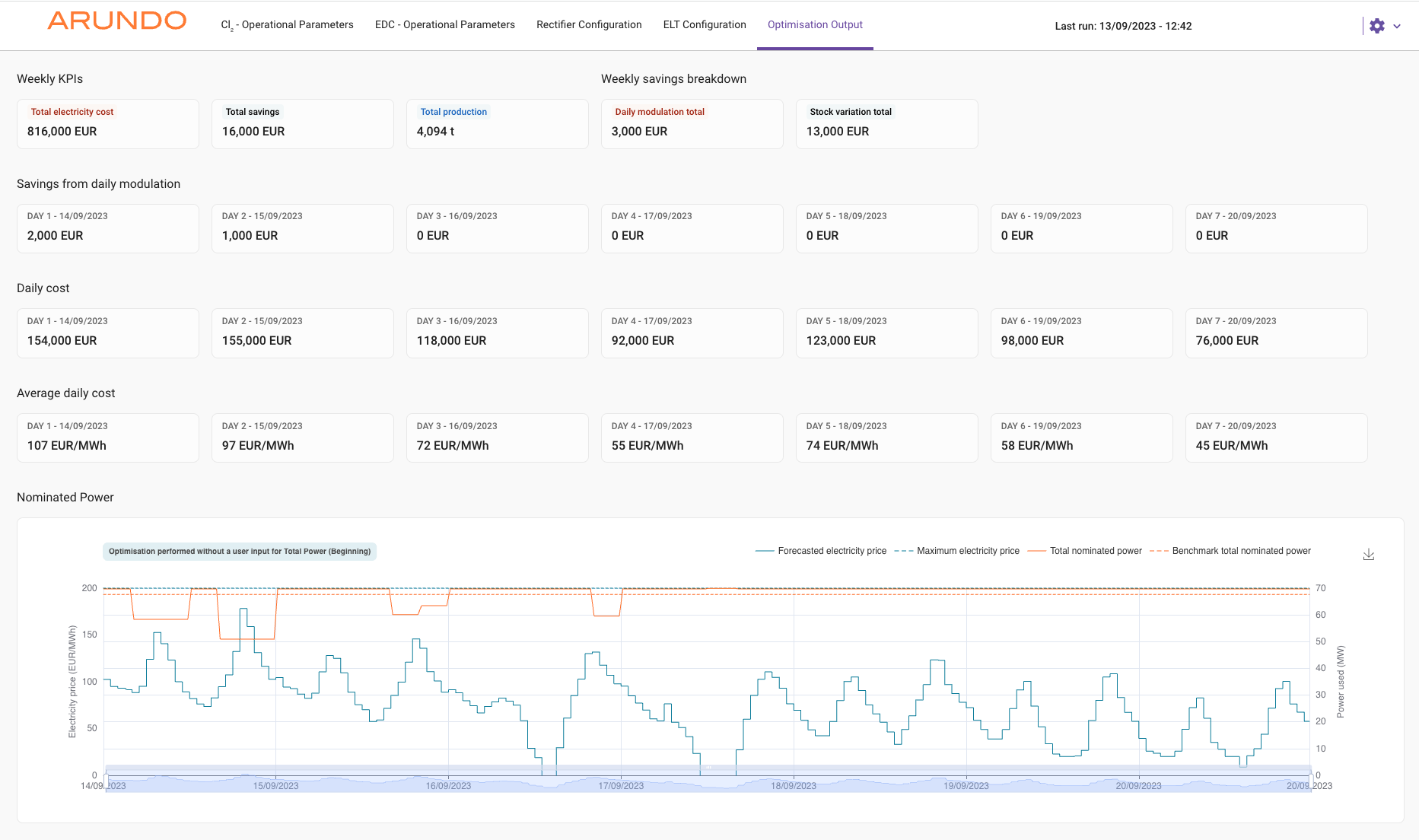
Energy Optimizer weekly optimisation output: weekly KPIs and savings breakdown, savings from daily modulation, daily cost and average daily cost for each of the seven days, and the nominated-power chart plotting the forecast electricity price against the total nominated power and its benchmark.
01 · CHEMICALS · MULTI-SITE, EUROPE

Cross-market energy optimisation

Energy is a chemical plant's biggest controllable cost — and energy prices differ by hour, by market, and by country. The Energy Optimizer, built on Foundation, answers the question every energy-intensive producer asks: what is the most energy-cost-efficient production plan? It schedules production — down to the optimal load-modulation schedule for individual units — against live local energy prices at each plant, then optimises across plants: with sites throughout Europe, the producer shifts production to wherever energy is cheapest, across energy markets and regions.

PROOF

3–5% energy cost savings from optimised scheduling; 5% EBITDA improvement across connected sites from cross-site production planning.

RETURNED

€8M/yr lower COGS from production planning optimized across sites and energy markets · 30× five-year ROI

LEVEL 2
THE LEVEL-2 POINT

single-plant optimisation is a model. Cross-market, cross-site optimisation requires one Domain spanning every plant — exactly what point tools can't do.
Energy Optimizer, in depth

02 · MARITIME · LNG CARRIER FLEET

Vessel performance & boil-off warranties

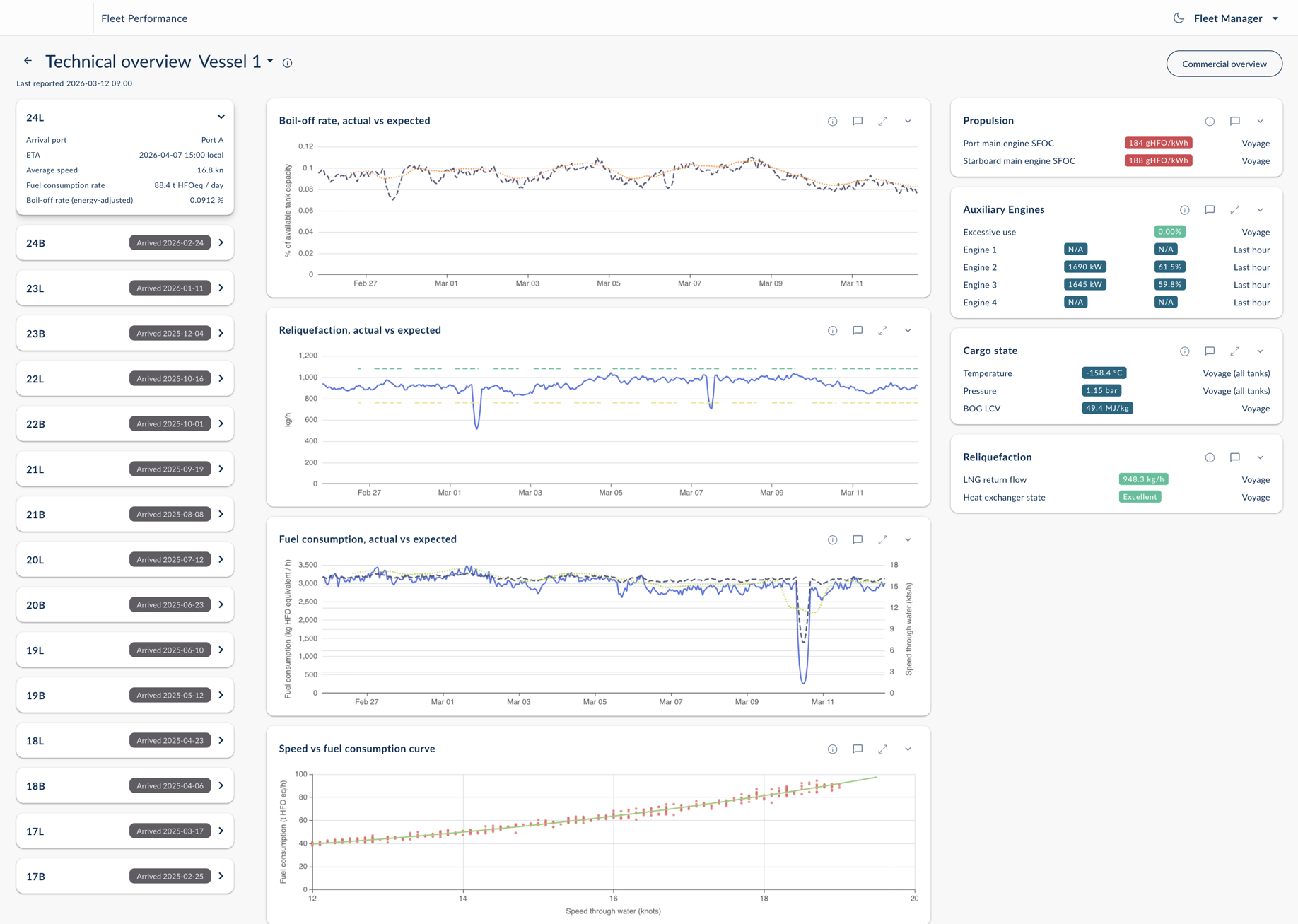
An LNG carrier's commercial performance is measured voyage by voyage — fuel consumption, boil-off rate, reliquefaction, hull performance — and boil-off warranties to cargo owners are contractual commitments. The industry's standard benchmarks come from vessel designs and sea trials; they drift out of relevance as vessels age and conditions change. The operator's Foundation solution benchmarks every voyage against the actual historical performance of comparable vessels, with similar cargo, under similar conditions — hundreds of measurements computed continuously across the fleet — and verifies warranty compliance with data, on every voyage. The Burn Recommender goes further, computing the optimal burn-vs-reliquefy trade-off for the boil-off gas system.

PROOF

over 90% of reliquefaction-system efficiency held within target bands; the entire fleet modelled in Foundation; 360 new measurements computed continuously.

LEVEL 2
THE LEVEL-2 POINT

warranty compliance needs trustworthy, continuous, cross-system measurement — a Domain that connects vessel telemetry, voyages, cargo data, and contracts.

Fleet performance dashboard in Arundo Foundation: one vessel's boil-off rate, reliquefaction mass, fuel consumption and speed–fuel curve, each plotted against its expected value, with propulsion, auxiliary engine, cargo state and reliquefaction readings alongside.
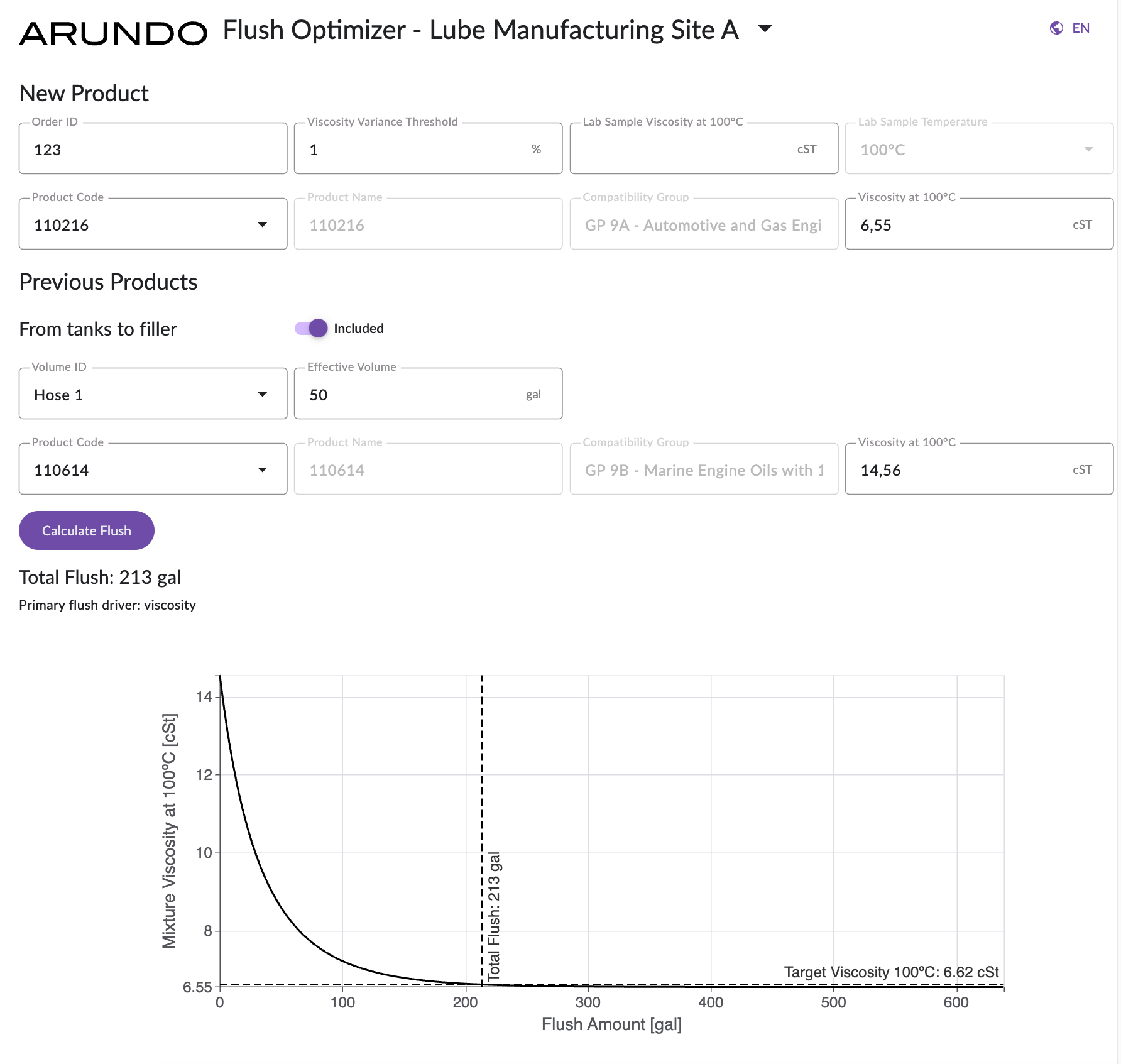
Flush Optimizer recommendation for one changeover: the new product and the previous product with their compatibility groups and viscosities, a 50-gallon hose segment, and the result — total flush 213 gallons, primary flush driver viscosity — above the mixture-viscosity curve falling to the 6.62 cSt target at the 213-gallon mark.
03 · LUBRICANTS · THREE SITES

Flush optimisation

Every product changeover on a lubricant packaging line means flushing — and industry-wide, 2–3% of annual lubricant production is lost to flush, with 20–30% of that flush volume avoidable. Static, product-family flush matrices over-flush by design. The Flush Optimizer, developed with a global lubricants producer, replaces them with physics: it solves the ASTM viscosity blending equation for the actual previous and next products to recommend the minimum flush volume that still passes the lab test — with first-fill logic, automatic second-flush guidance, and self-service configuration for any line. Next: optimising the changeover sequence itself, so the production plan minimises total flush.

PROOF

consistent flush-volume reductions of more than 15% across three sites — up to 18% — with first-time-right manufacturing performance maintained.

RETURNED

$20M/yr value added on lubricant changeovers · 27× five-year ROI

LEVEL 2
THE LEVEL-2 POINT

per-changeover physics plus schedule-wide optimisation — a model and a planner sharing one Domain.

Flush Optimizer, in depth

04 · PETROCHEMICALS · WITH TECHNIP ENERGIES

Ethylene production optimisation — Technip Energies (SAM)

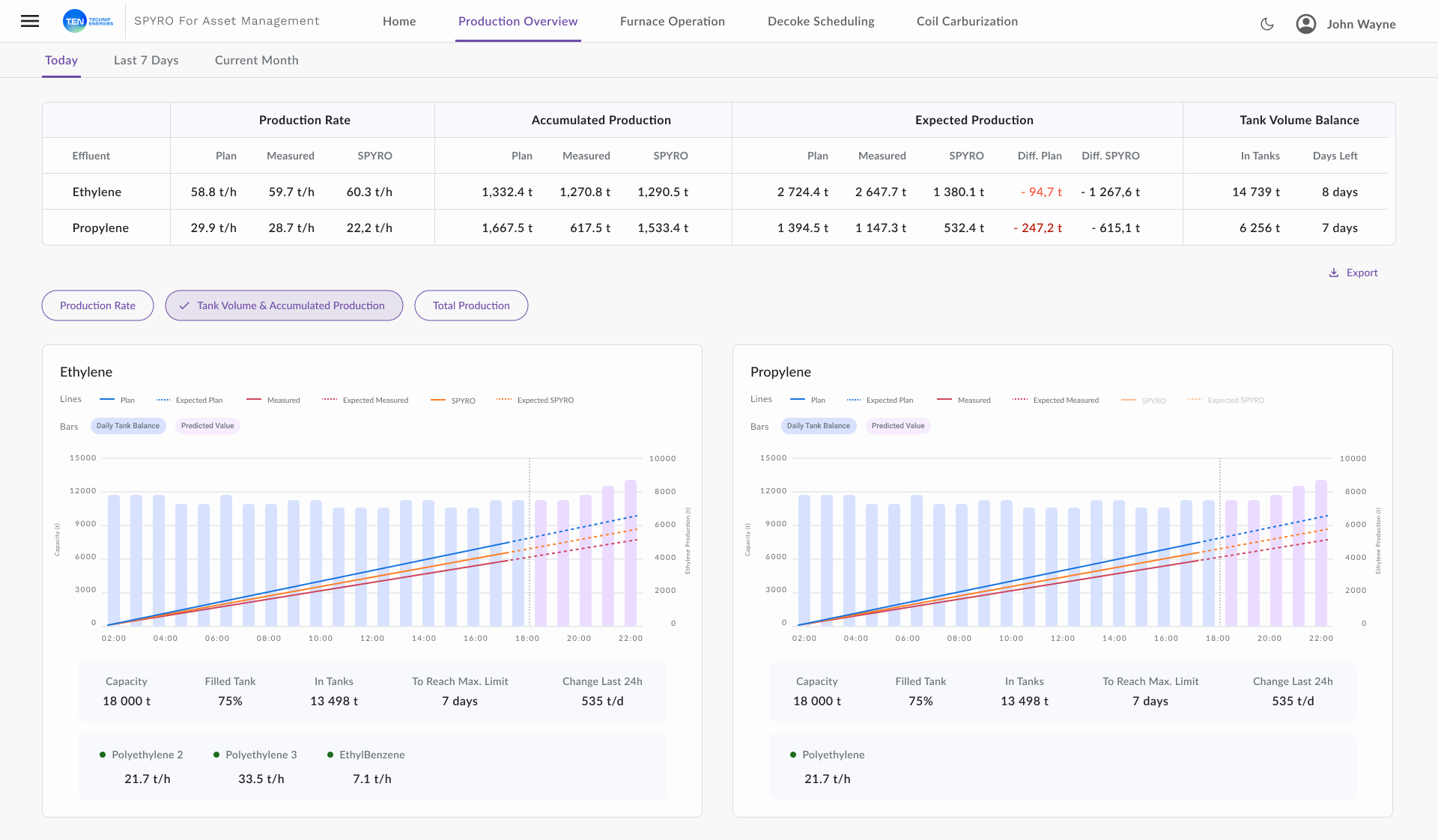
SPYRO® is Technip Energies' proprietary steam-cracking simulator — adopted by roughly 80% of ethylene producers worldwide since 1979. SAM (SPYRO® for Asset Management), built with Arundo, connects that simulator to live plant data in Foundation: real-time simulation of every furnace, continuously. Operators see actual vs planned vs optimal yield, get decoke schedules that maximise furnace availability, track coil carburization and remaining run length, benchmark furnaces against each other, and are alerted the moment operation deviates from set boundaries — with feedstock mix balanced against coking and decoking cycles across the plant.

PROOF

+2–3% ethylene yield from real-time optimization — on a simulator already trusted by ~80% of the world's ethylene producers.

"Arundo enables us to digitalize the USD 125 Billion ethylene market."

Marco Van Goethem, Manager Digital Solutions, Technip Energies
LEVEL 2
THE LEVEL-2 POINT

the world's most-used ethylene simulator, running live against the plant's Domain — simulation as a continuous service, not an offline study.

SAM production overview for today: ethylene and propylene production rate, accumulated and expected production, each as plan, measured and SPYRO-simulated, with tank volume balance; below, per-product charts of plan, measured and SPYRO lines over the day against daily tank balance, and capacity, fill level and consumer offtake.

OFF THE SHELF, ON FOUNDATION.

Energy Optimizer — intelligent production scheduling for volatile energy markets. The productised core of the cross-market energy solution above.

Flush Optimizer — minimum-flush recommendations for any packaging or transfer line, configurable in self-service.

Edge — IoT data integration, edge AI, and cloud connectivity for assets beyond the network's reach.

CarbonPath — automated Scope 3 emissions management and reporting for the maritime value chain.

AUTONOMOUS MARITIME OPERATIONS

The scale doesn't stop at the shoreline. Arundo runs autonomous operations at sea: fleet performance across an LNG carrier fleet (>90% reliquefaction efficiency across the fleet), CarbonPath for continuous emissions compliance, and a decade of edge deployments on vessels beyond any network's reach.

"Arundo's solution will enable MacGregor to offer digitally enhanced services and lifetime support to their customers with cargo handling and offshore solutions for maritime transport and offshore industries."

MacGregor
>90%customer retention
~85%of customers continue to invest
100+projects since 2015
“We were looking for a partner with a mature analytics solution — Arundo was a perfect match. We can see tomorrow, today.”
Daniel Lundberg — Director Offshore Business Line, MacGregor

The track record

69 stories

A decade in asset-heavy operations leaves a paper trail. Here it is — the use cases behind the solutions above, by industry.

INDUSTRY

1000x speed increase in fatigue monitoring of flexible risers

1000x faster fatigue insights than traditional FEA models, at over 98% accuracy.

5x ROI from investing in corrosion management of pipelines and avoiding pipeline integrity risks

The automation alone delivered at least a 5x return on investment in pipeline corrosion management.

Optimizing water consumption: Advanced analytics enabling annual savings of up to $5M

Advanced analytics enabling annual savings of up to $5M: on-vessel water quantity reduced 15% across the fleet.

Avoiding potential misconnection and shock hazard on smart meter installations: Enabled savings of up to $8.5 million

Avoiding misconnection and shock hazards on smart meter installations: up to $8.5 million in potential lost value identified.

Distillation process optimization in chemical plant

An estimated USD 250,000 reduction in annual costs from stabilizing distillation column temperature in VCM production.

Eliminating over-maintenance of pumps

Slashing unnecessary maintenance visits by 50% at an oil and gas customer through data-driven insights.

Heat Exchanger Performance Monitoring

A reduction of 5-7 million USD in annual production losses from heat exchanger cleaning and failures.

Predict and optimize repair routes: Offshore logistics forecasting product expected to reduce NPT by 15%

Offshore logistics forecasting predicts and optimizes repair routes: 15% NPT decrease and 22% higher equipment utilization expected.

Optimizing demineralized water production

20% reduction in annual pump electricity costs and 25% reduction in annual maintenance spending.

Alkylation and Transalkylation Catalyst Monitoring

An innovative pilot program successfully demonstrated the value of real-time catalyst monitoring for an oil and gas facility, paving the way for significant cost savings.

Benchmarking asset performance: Leveraging data-driven insights to save operating and maintenance costs

Extracting and analyzing asset performance and equipment failure rates using a suite of software analytics to benchmark performance

Biomass Plant Emission Prediction

Getting ahead of emissions regulations and avoiding fines with prediction models delivered in just three weeks.

Cold Load Pickup Estimation for Electricity Transmitter/Distributor

By improving their ability to manage Cold Load Pickup (CLPU), a Utility Transmission & Distribution (T&D) provider has been able to improve their service delivery and will have more actionable insights into future CAPEX/OPEX send.

Reducing failure and boosting productivity for gas compressors: Decreased maintenance spend

Check out how we used a condition-based monitoring solution to reduce a large oil company's yearly equipment maintenance costs.

Significantly improving safety: Reducing hazardous leaks in heat exchangers

Reducing hazardous leakage risk, improving on-site safety using a condition-based monitoring platform for heat exchangers.

Empowering Subsea Equipment Owners with Operational Diagnostics

Subsea equipment owner improves operational insights and anomaly detection with Arundo's diagnostics solution.

Engine Monitoring for Heavy Equipment Dealership

Data-driven insights to improve heavy equipment maintenance and reduce downtime.

Transforming crane maintenance: Implementing data-driven approaches to reduce unplanned downtime

An offshore crane OEM had ambitions to be a trusted service provider implementing a proactive approach to maintenance routines and equipment monitoring using data science and analytics.

Operational diagnostics for commercial vessels

Building a data-driven application to optimize ship operations

Maximizing maritime efficiency: Streamline shipping operations with cutting-edge software solutions

Operational diagnostics for a global shipping company.

Optimizing solar farm maintenance

Applying machine learning on solar panel telemetry to better predict remaining useful life

Solving Oil in Water Challenges for Offshore Operations

An offshore operator successfully addressed regulatory exceedances and production issues with a data-driven approach to analyzing and reducing oil in produced water.

Compressor anomaly detection: two weeks' warning of a dry gas seal failure

An alert two weeks ahead of a dry gas seal failure on an export compressor; 300–370 kboe of production loss avoided on the one failure identified, USD 12–16 million a year in value.

Computer vision for product identification on production lines

Deep-learning vision that identifies every stock-keeping unit with 100% accuracy and labels new ones in real time without retraining.

Offshore crane uptime up 10–15% across a live vessel fleet

Co-developed on-vessel condition monitoring with more than 100 KPIs and machine learning models: 10–15% more crane uptime across the vessel fleet, offshore and merchant.

Critical-equipment monitoring for a cruise-ship yard

Eight reliability use cases discovered on the steel, pre-treatment and plate-cutting lines, three prioritised for a first pilot; an hour of line downtime costs up to EUR 50,000.

Distillation yield from simulation-recommended setpoints

Replaying 2.5 years of campaigns through the site's simulator found about 4 percentage points of average yield headroom — worth around EUR 1.3 million a year.

Extending catalyst lifetime with predictive deactivation modelling

Forecasts of the days until a catalyst repack, within about 15 days, so repacks are planned instead of forced.

A 'factory of the future' programme for a multinational manufacturer

Key equipment across sites connected to the cloud, with analytical models at machine, plant and network level: USD 6–10 million from utilisation and USD 30–40 million from efficiency.

Forecasting a fleet's operating expenses with machine learning

Machine learning on historical opex and its drivers predicted a tanker fleet's operating expenses 25–35% more accurately than the traditional methods.

Predicting crack formation in gas combustion units on LNG carriers

A data signature that predicts cracks in the GCU cooling jacket, alerting crew before the most common failure: USD 200–300 thousand a year in repair and maintenance savings.

Generator condition monitoring on an unmanned platform

Alerts raised two to four weeks before most generator failures; USD 1–2 million a year less production lost.

Unplanned haul-truck engine downtime cut 15% for an alumina miner

Alarm, work-order and telemetry history turned into early warning of the engine and overhaul failures that drive a mining fleet's unplanned downtime.

Heat-exchanger fouling monitoring across a chemicals group's sites

A business case to move heat-exchanger maintenance from planned to condition-based across 50 sites, built on a pilot where differential pressure proved the tell-tale sign of fouling.

Initial production prediction from 285,000 onshore wells

A data-driven model trained on 285,000 wells across several basins replaces decline-curve analogues for predicting a new well's initial production.

Three million invoices a year, classified with natural language processing

Deep learning learned an E&P company's invoice filing logic, corrected hundreds of thousands of historical errors and now flags new ones.

Logistics control for onshore water hauling

Vendor billing matched to the physical flow at unmanned tank sites, with no manual review: USD 1.8 million a year saved across 100 sites.

Fleet monitoring for an offshore wind operator

Fleet-wide early warning of turbine failures, so vessels and maintenance staff are scheduled to the fault rather than the weather window: a 15% average improvement in uptime.

Increasing paste-ink throughput with predictive risk scoring

A weekly risk score that predicts which ink orders will need post-test adjustment, with about 90% accuracy, so planners schedule around them.

Predicting LNG cargo loss to boil-off at voyage start

A model that predicts a voyage's cargo loss within about ±2% from ten facts known at loading, so hard cargoes are flagged before departure.

Reachstacker reliability from sensor, event and service data

In 14 days on ten machines: reachstackers with service windows over about 350 hours were 2–5× more likely to have an oil leak per 1,000 hours, and high transmission-oil temperature traced to debris on the radiator.

Solar inverter failure detection, classification and early warning across four plants

Models that detect production-loss events on inverters, classify them by failure type, and flag the intermittent power-loss pattern that precedes longer outages: 8% of production losses avoided in a live pilot.

Two months' warning hidden in a compressor's telemetry

A critical compressor failed with no alarm. Reanalysis showed the failure could have been seen two months earlier.

Audio-based predictive maintenance in hydropower plants

A pilot with one of the world's largest hydropower companies on 30 plants sharing the same stator type, where rare failures make collaborative modelling essential.

Automated well-log interpretation

An unsupervised model on raw well-log data that finds the abrupt changes marking layers of interest, accelerating interpretation and making it consistent.

Auxiliary generator optimisation for a tanker fleet, phase 1

Six months of data from the four auxiliary engines on three sister vessels assessed and mapped, establishing the base for generator optimisation and fleet benchmarking.

Blowout preventer condition monitoring for an upstream operator

Live BOP data streamed to the cloud, valve cycle counts automated, and condition-based maintenance made possible under the 21-day testing regime.

Compressor management for an upstream major, with an engineering partner

Real-time compressor condition monitoring, anomaly detection and root-cause recommendations proposed with an engineering partner, on an approach proven on four offshore platforms for two operators.

Condition monitoring pilot scoped for a dry-bulk fleet

A fleet-monitoring pilot scoped for a shipping line: use-case identification, edge integration, asset hierarchy, first analytical models, and a two-month evaluation on live data.

De-risking battery storage as a service with fleet-wide digital twins

A battery-storage digital twin template, scheduled anomaly detection and an AI agent in the team's chat, so a 100-unit fleet is monitored from day one.

Digital field development planning with a national oil company

Historic sensor, failure and maintenance data for wells, processing and export turned into a reliability model of the host platform, to choose the concept for an offshore tie-back.

A drill-pipe tally from a laser at the wellsite, streamed over 4G

Laser measurements from a ruggedised wellsite enclosure streamed through Arundo Edge over 4G into a tally-sheet application, with compute chains removing duplicate and fluttering readings.

Flush Optimizer pilot on a 20-litre packaging line

A two-phase pilot: configure the line's topology and products, establish a flush baseline from history, then use the recommendations live and measure the reduction.

Flush-reduction feasibility for a lubricant blender

Can historical changeover data predict the flush a line needs? A feasibility scan on viscosity, calcium, colour and infrared results from a blender's highest-changeover filling line.

Fugitive emissions detection from infrared drone footage

Computer vision shown able to take over the manual interpretation of infrared footage used to find fugitive emissions.

Measuring gas combustion unit vibrations to verify repairs and compare the fleet

Vibration sensors on three vessels' GCUs, streamed through Arundo Edge, gave the operator objective evidence that a burner replacement reduced vibration.

Golden-setpoint quality prediction for a superabsorber plant

A feasibility study to predict a key quality indicator from process data at the moment the lab sample is taken, as the base for recommending setpoints that hit the target.

Just-in-time maintenance: a blind test on a drilling contractor's compressor

Sensor and maintenance history blended and auto-grouped, with adaptive learning that removes retraining, tested blind against a compressor's recorded rebundling, bearing and sensor events.

Predictive maintenance for thirteen gas compressors across five sites

A proof of concept on one compressor, then scaling to twelve more, proposed for a gas producer with no usable history and few sensors.

Anomaly detection across a pressure-pumping fleet

Real-time anomaly detection on pump fluid ends, scaled across operating locations, with comparative tools that find underperforming pumps early.

Prescriptive maintenance for pressure-pumping power ends at scale

Predictive models that spot anomalous operating conditions on pump power ends and name the ancillary equipment to replace before the power end fails, scaled across the fleets.

A pump maker's first digitised pump offering

Arundo Edge and condition-and-performance monitoring configured for a manufacturer's centrifugal pumps, qualified at its test facility and ready for customer roll-out.

Pumps run back toward their best efficiency point

A fleet-wide efficiency view that shows which pumps drift from their best efficiency point, improving reliability and cutting energy and CO2.

Raw-mill liner wear forecasting and gearbox failure monitoring

A forecast of the day the mill's roller liners reach their wear limit, and a continuous gearbox health metric trained on the failure the plant had already lived through.

Root-cause analysis of PVC quality variance and boiler fouling

Two root-cause analyses on historical plant data: why PVC quality drifted off spec, and which leading indicators precede boiler fouling.

Solar inverter event detection from four years of plant data

Four years of minute-level data from 30 inverters and 11 weather stations analysed: inverter events can be detected automatically with high confidence, and inverter output predicted from weather.

A virtual multiphase flow meter, co-developed with an automation vendor

Real-time oil, gas and water rates per well calculated from existing measurements, written back to the customer's data store or dashboard.

Predicting gas breakthrough from 4D seismic

Machine learning linking 4D seismic to production-logging results, so gas development in the reservoir can be followed without shutting the well in.

Production forecasts for wind and solar farms, every five minutes

Machine-learning production forecasts for a wind farm and a solar farm, computed at the edge and served to the market operator's API.

Your problem isn't on this page? Good.

Nothing above is a product line you must fit into. It is evidence of a method: more than a hundred solutions delivered since 2015 — corrosion, fouling, compressors, cranes, columns, catalysts, cold-load pickup, water, solar, subsea, pipelines, wind forecasting, and a pressure-pumping fleet where reliability work returned $7–9M a year. Every one started the same way: an operator with a real problem, and the data to solve it.

That is what we are looking for. If your problem is real and your data exists — or could — we want to build the solution with you, on Foundation, with your engineers and operators in the room. Each one strengthens your Domain, and each one moves your plant up the scale.

Bring us your hardest problem

Book a use-case workshop